

Kaleidoscope Quilt Engineering: Beyond Pretty Pictures
On-Point Quilt Blocks: The Foundation of Accurate Quilt Design (and Why It Matters for Octagon Kaleidoscope Quilts)
One of the most misunderstood concepts in quilt design is the difference between a “square block” and an “on-point block”. While rotating a square block 45 degrees may seem simple, that rotation completely changes the geometry of the quilt. Understanding this principle is essential when designing quilts with octagonal kaleidoscope blocks, One Block Wonders, Stack-and-Whack quilts, and many modern layouts.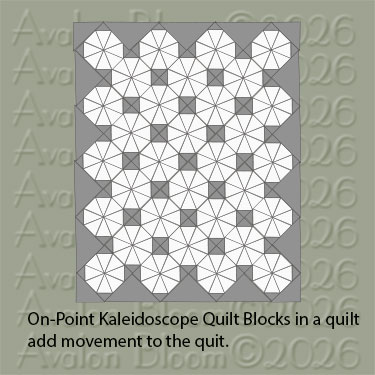
Unfortunately, many quilt patterns found online ignore these geometric rules. The result is blocks that appear acceptable in illustrations but become distorted, mismatched, or impossible to piece accurately.
What Is an On-Point Quilt Block?
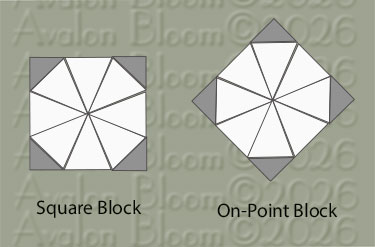
A quilt block is considered “on-point” when it is rotated 45 degrees”, so one corner points upward instead of one side being horizontal.
Although it appears to be only rotated, the mathematics of how neighboring blocks connect changes completely.
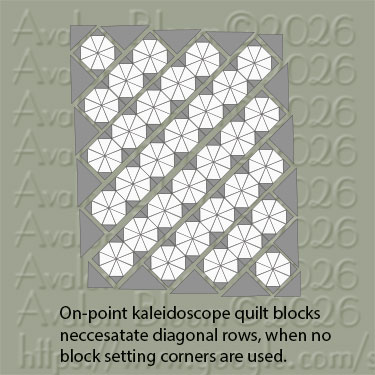
The block is no longer bordered by vertical and horizontal seams. Instead, the seams travel diagonally across the quilt.
This affects:
- Seam intersections
- Grain direction
- Corner dimensions
- Setting triangles
- Border construction
- Adjacent block drafting
Why On-Point Layouts Are Important
Designers use on-point layouts because they create movement. Instead of rows and columns, the eye naturally follows diagonal pathways across the quilt.
Benefits include:
- greater visual energy
- more dynamic secondary patterns
- stronger directional flow
- less obvious block repetition
- enhanced kaleidoscope effects
Many traditional quilts—including Irish Chain, Ohio Star variations, and numerous medallion quilts—use on-point settings for exactly this reason.
The Geometry Changes Completely
When a square rotates 45°, its width is no longer equal to the side length.
Instead, the finished width becomes:
Diagonal=s√2 (√2=1.41421356237)
where “s” is the finished block size.
For example:
- 8" square block
- diagonal ≈ 11.31”
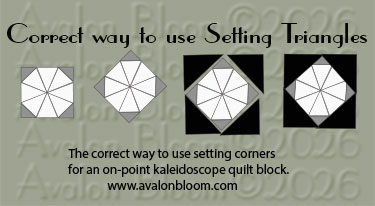
This is why setting triangles exist. Without them, the quilt cannot have straight outer edges.
Why Octagon Kaleidoscope Blocks Are Different
Octagon kaleidoscope blocks introduce another layer of geometry. Unlike ordinary square blocks, the finished block is actually an octagon created from angled edges. Those angled edges often meet neighboring pieces at 22.5°, 45°, or 67.5° depending on the drafting method. The beauty of kaleidoscope quilts comes from these repeated angular relationships.
Every seam contributes to the illusion. If one adjoining piece is drafted incorrectly—even by a small amount—the repeating geometry breaks down.
The Hidden Challenge: Splitting an On-Point Octagon Block
One of the most common design mistakes occurs when a designer wants to divide an on-point octagon block evenly along a seam.
Imagine an octagon rotated on point.
A diagonal seam cuts the block perfectly in half.
Many designers simply draw a straight line and assume each half can be sewn directly to neighboring blocks.
That assumption is incorrect.
The moment an octagon is divided, each half loses the geometry needed to fit back into a square grid.
The missing corners must be restored through additional drafted pieces.
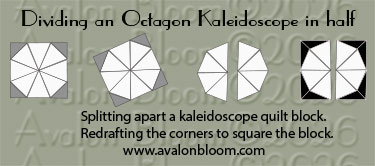
Re-Squaring the Block
Without those pieces:
- seam allowances don't align
- neighboring blocks shift
- points are truncated
- rows refuse to stay square
This is one of the most important drafting concepts in kaleidoscope quilting.
Whenever an octagon block is:
- split into halves,
- rotated on point,
- inserted into a square grid,
the resulting shape is “not square anymore”.
It must be “re-squared”.
Re-squaring means drafting companion pieces that restore the outside dimensions of the unit so it once again fits into the quilt's square grid.
These companion pieces may be:
- triangles
- trapezoids
- kites
- partial diamonds
- custom polygons
Their purpose is not decorative.
Their purpose is geometric.
They recreate the missing corners needed for accurate assembly.
Why Equal Halves Still Require Additional Pieces
Many people assume:
"If I split the block exactly in half, the two pieces should fit."
That is not true.
Most quilts are built on a square grid.
The square grid demands square units.
Therefore every non-square shape eventually needs companion pieces that restore the square.
This is true for:
- Lone Star diamonds
- Lemoyne Stars
- Flying Geese
- New York Beauty blocks
- Octagon kaleidoscopes
The mathematics is identical.
Where Many Kaleidoscope Quilt Patterns Go Wrong
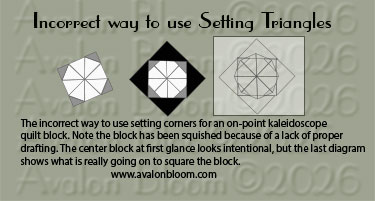
The internet is filled with computer-generated (and human drafted) quilt diagrams that look convincing but ignore proper drafting.
Common mistakes include:
1. Assuming rotation changes nothing
Rotating a block changes every adjoining seam orientation.
Ignoring this produces mismatched intersections.
2. Using identical filler pieces everywhere
Different edges often require different companion pieces.
Copying one triangle repeatedly rarely works.
3. Forgetting seam allowance geometry
A block that measures correctly without seam allowances may finish incorrectly once sewn.
Accurate drafting must account for the stitching line—not just the cut edge.
4. Distorting the octagon
Some designers stretch an octagon until it visually fills a square, or squish it.
Although it appears correct on a computer screen, the resulting angles are no longer mathematically accurate.
The kaleidoscope symmetry is lost. Note the photo above that shows what went on behind the block, unnecessarily, to get the front to kind of work.
Why Accurate Drafting Matters
Kaleidoscope quilts depend on precision more than almost any other quilt style.
Every repeated motif amplifies even tiny drafting errors.
If one angle is incorrect:
- neighboring blocks drift
- secondary patterns disappear
- points fail to meet
- borders become uneven
- the finished quilt may not lie flat
Conversely, accurately drafted companion pieces allow every octagon to maintain its proportions while fitting perfectly within a square-based quilt layout.
The result is crisp intersections, seamless optical effects, and a quilt that assembles exactly as intended.
The Avalon Bloom Difference: Where Beautiful Design Meets Precision Drafting
At Avalon Bloom, we believe a truly exceptional kaleidoscope quilt is built on more than beautiful fabric—it begins with accurate geometry. An on-point quilt is far more than a square rotated 45 degrees. That simple rotation changes the relationship of every seam, every adjoining piece, and every angle in the design. Nowhere is this more important than in our octagon kaleidoscope quilts, where precision drafting ensures each block works in harmony with the next to create the stunning secondary patterns our customers love.
Our designs don't rely on approximations or shortcuts. When an on-point octagon is divided along a seam, it no longer fits naturally within a square grid. That's why we carefully draft the companion pieces needed to re-square every unit, preserving the proportions of the octagon and ensuring every seam aligns exactly as intended. This level of drafting isn't always visible at first glance, but you'll appreciate the difference when your quilt pieces fit together accurately and your points meet cleanly.
We've seen many quilt patterns that capture the look of a kaleidoscope quilt on paper or on a computer screen but overlook the geometry required to make the design sew correctly. The result can be distorted shapes, mismatched seams, unnecessary frustration, and a finished quilt that never quite achieves the beauty of the original concept.
At Avalon Bloom, precision is part of every design we create. We believe quilting should be an enjoyable experience, not a geometry lesson. By investing the time to solve the mathematical challenges behind each pattern, we allow you to focus on what you love most—choosing beautiful fabrics, sewing with confidence, and creating a kaleidoscope quilt that comes together as beautifully in your sewing room as it does in our photographs.


 About Us